
From a Milford Arrest to GA 22 Court
Milford is a Connecticut city, not a county with its own sheriff or district attorney. So the road from an arrest to a court record runs through state systems. A Milford Police officer makes the arrest. The department processes the person, writes a report, and either releases them on a promise to appear or bond, or holds them for court or the Connecticut Department of Correction. From there the case heads to Superior Court, where a prosecutor reviews it and files the charges. Only then does a full court record exist that the public can search.
Most local criminal and motor vehicle matters land at Geographical Area No. 22 in Milford. Serious felonies route to the Ansonia-Milford Judicial District, which shares the same courthouse. The arrest record and the court record describe the same event but serve different jobs. The booking side, including custody status and any booking photo, sits with the police and corrections systems covered on the jail inmate records page and the jail roster mugshots page. The court record is the case file the prosecutor builds, and that is what you search in the Connecticut Judicial Branch case lookup.
The pathway in short: Arrest by Milford Police, then local processing and a report, then release on a promise to appear or bond or transfer into custody, then arraignment at GA 22 or the Judicial District, then prosecutor review of the charges, and finally the case appearing in the Connecticut Judicial criminal and motor vehicle lookup.
Who Files Charges After a Milford Arrest
Connecticut prosecutes crime through State's Attorneys in the Division of Criminal Justice, not through a county DA. The Office of the State's Attorney for the Ansonia-Milford Judicial District handles cases from Milford, West Haven, and seven other towns. The State's Attorney, Margaret E. Kelley, leads that office. Her prosecutors decide which charges to file, which to amend, and which to drop after reviewing the police report. That review is why the charges in a court record can differ from the charges listed at booking.
The office splits work by case weight. Serious Part A felonies go to the State's Attorney's Part A team. Lower-level Part B matters, meaning class C, D, and E felonies, misdemeanors, infractions, and motor vehicle offenses from Milford and West Haven, are handled at GA 22. The prosecutor represents the State of Connecticut and the public welfare, not the victim as private counsel.
The Ansonia-Milford State's Attorney publishes its office and court locations online. The lead-in to its directions page helps confirm where to call about a charging decision and which team holds a case.
You can see the office and court contacts on the Ansonia-Milford State's Attorney locations and directions page.
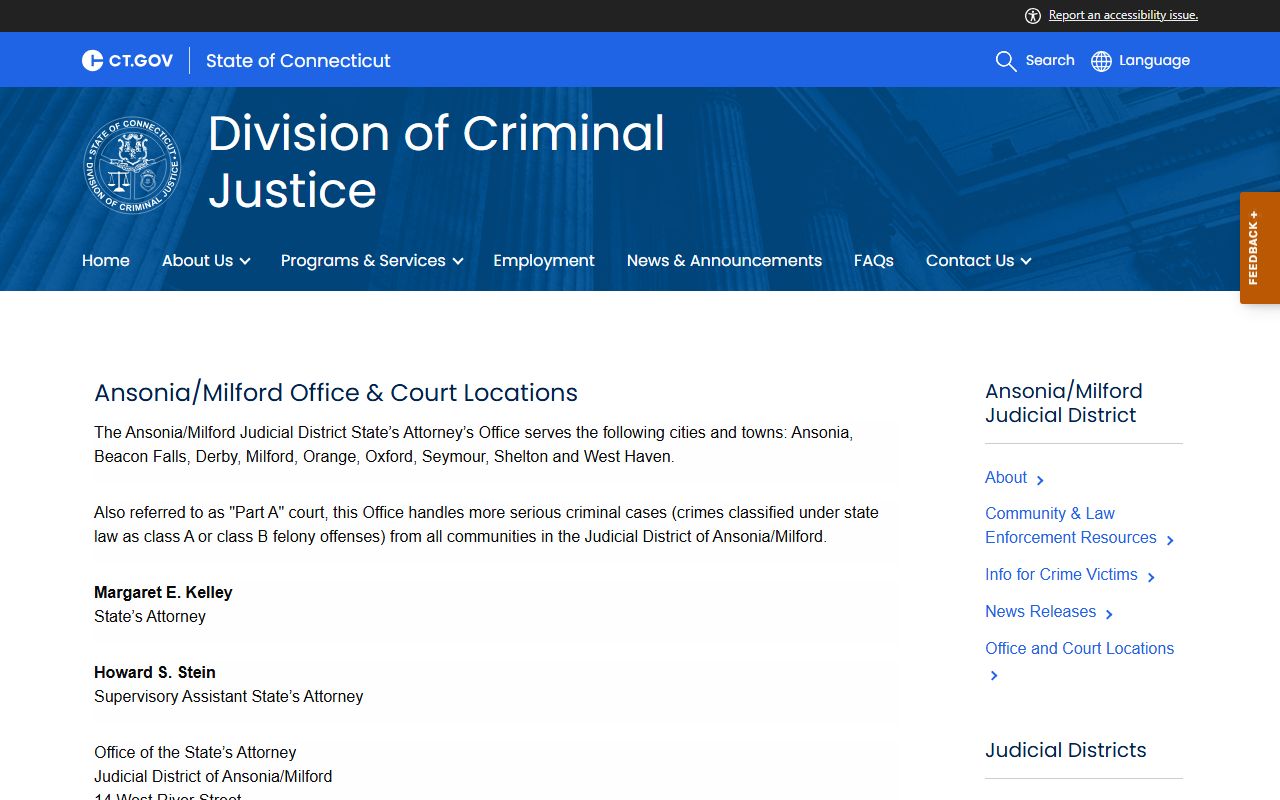
That listing names the prosecutors for both the Part A team and the GA 22 Part B team, which is helpful when a charging question needs the right desk rather than the clerk.
State's Attorney, Part A (Serious Cases)
Judicial District of Ansonia/Milford
14 West River Street
Milford, CT 06460
(203) 874-3361
State's Attorney Margaret E. Kelley
Email conndcj@ct.gov
GA 22 Part B (Milford and West Haven)
14 West River Street
Milford, CT 06460
(203) 874-3017
Supervisory Assistant State's Attorney Matthew Kalthoff
Email conndcj@ct.gov
Searching Pending Court Records by Defendant
When a case is still open, you find it through the Connecticut Judicial Branch pending criminal and motor vehicle lookup. The search runs on a defendant's last name and narrows from there. The court record you reach shows the charges, the court location, and the schedule. Arrest and booking detail does not appear in this lookup, because that lives in the police and custody systems instead.
The defendant search begins with the last name and accepts a first initial, a birth year, and a year range to cut down on matches. A court location dropdown lets you target Milford GA 22 or the Milford Judicial District directly.
| Field | Type | Required | Notes |
|---|---|---|---|
| Last Name (begins with) | Text | Yes | Up to 60 characters |
| First Initial | Text | No | One character |
| Birth Year | Text | No | Four digits |
| Year Range (+ or -) | Text | No | One character |
| Court Location | Dropdown | No | Includes Milford GA 22 (A22M) and Milford Judicial District (AAN) |
| CategoryType | Dropdown | No | Blank, Criminal, Motor Vehicle, or MV/Boat License/Reg Suspension |
The search-field layout above mirrors the live form. The lead-in to that form shows the Milford court dropdowns and the page timestamp.
You can run a name search on the Connecticut Judicial pending case by defendant lookup.
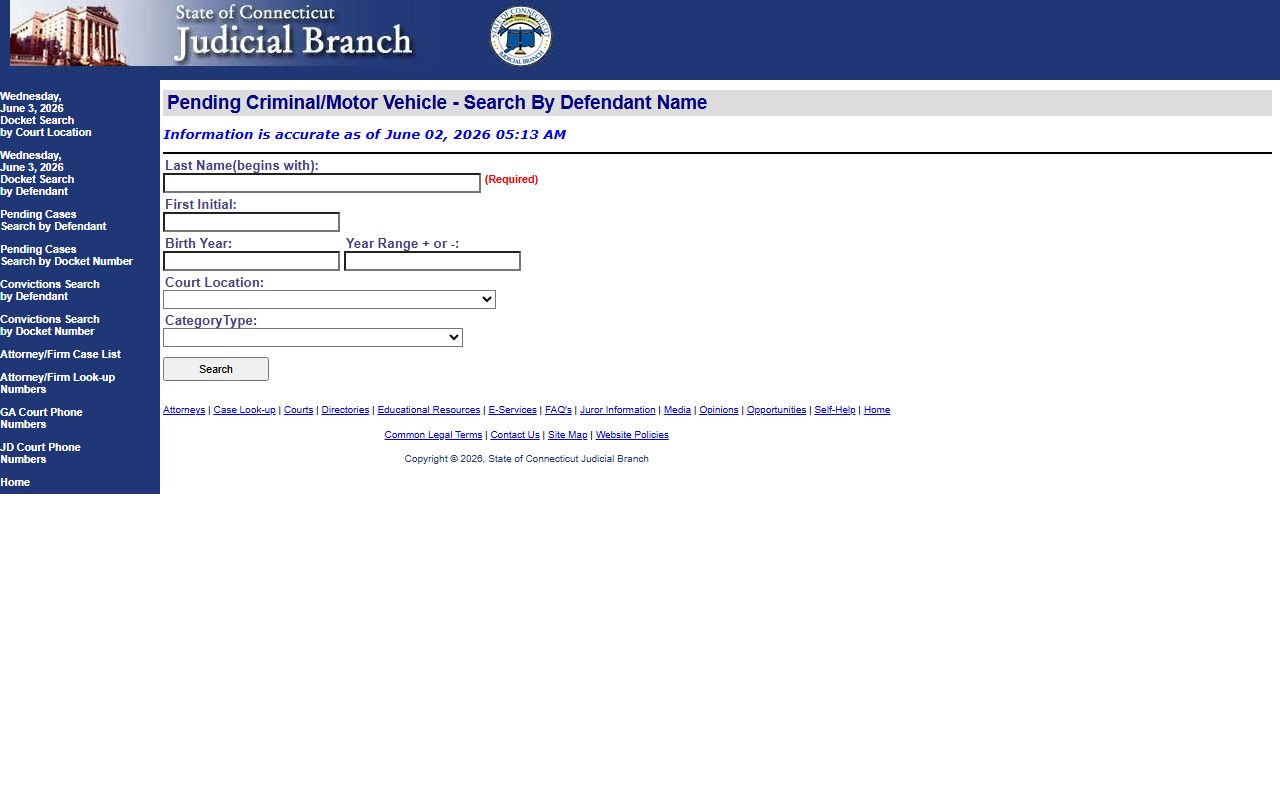
That page is where a Milford court record first becomes searchable once a prosecutor has filed and the clerk has entered the case.
- Gather the person's exact last name, a first initial, and a birth year if you have one.
- Open the pending case by defendant lookup and type the last name.
- Set Court Location to Milford GA 22 for most local matters, or the Milford Judicial District for serious cases.
- Open the matching case and read the charge list, the court location, and each charge's current status.
Searching Court Records by Docket Number
If you already have the docket number from a court notice, a bond paper, or a press release, you can pull the case directly. The docket lookup is faster than a name search because it points at one case. It asks you to pick the court, the case type, and then enter the year and number printed on the docket.
| Field | Type | Required | Notes |
|---|---|---|---|
| GA/JD | Dropdown | Yes | Includes A22M and AAN for Milford |
| Type | Dropdown | Yes | CR, MV, CI, or MI |
| Year | Text | Yes | Two digits |
| Number | Text | Yes | Up to seven digits |
| Suffix | Dropdown | No | S, T, A, or 0 through 9 |
Match the dropdowns to the codes on your paperwork, then enter the year and number exactly. You can run a docket search on the Connecticut Judicial pending case by docket number lookup.
Daily Dockets at Milford Court
To see who is scheduled in court today, use the daily docket tools. One version searches by court, so you can choose Milford GA 22 or the Milford Judicial District and view the day's list. The other searches the same day by a defendant's last name. These tools answer a narrow question: who is on the calendar right now.
Daily dockets carry an important limit. They show the current date only, and they do not include add-on dockets that get scheduled after the list is published. So a hearing can be real even when it is missing from the daily view. For a fuller picture, use the pending case lookups above rather than the daily docket alone.
You can browse the calendar through the daily docket by court or the daily docket by defendant.
Note: A daily docket reflects only the current date and leaves out add-on dockets, so confirm a hearing with the clerk before you rely on it.
GA 22 Court Location and the Clerk
The Milford courthouse sits at 14 West River Street and serves both GA 22 and the Ansonia-Milford Judicial District. When a record is not online, or you need a certified copy, the clerk's office is the place to ask. The clerk can confirm a court date, point you to a file, and explain what is and is not part of the public record.
The Judicial Branch publishes directions and the clerk phone for this location. The lead-in to that directory page gives the address and the clerk contact in one place.
You can view the address and clerk details on the Geographical Area No. 22 at Milford directions page.
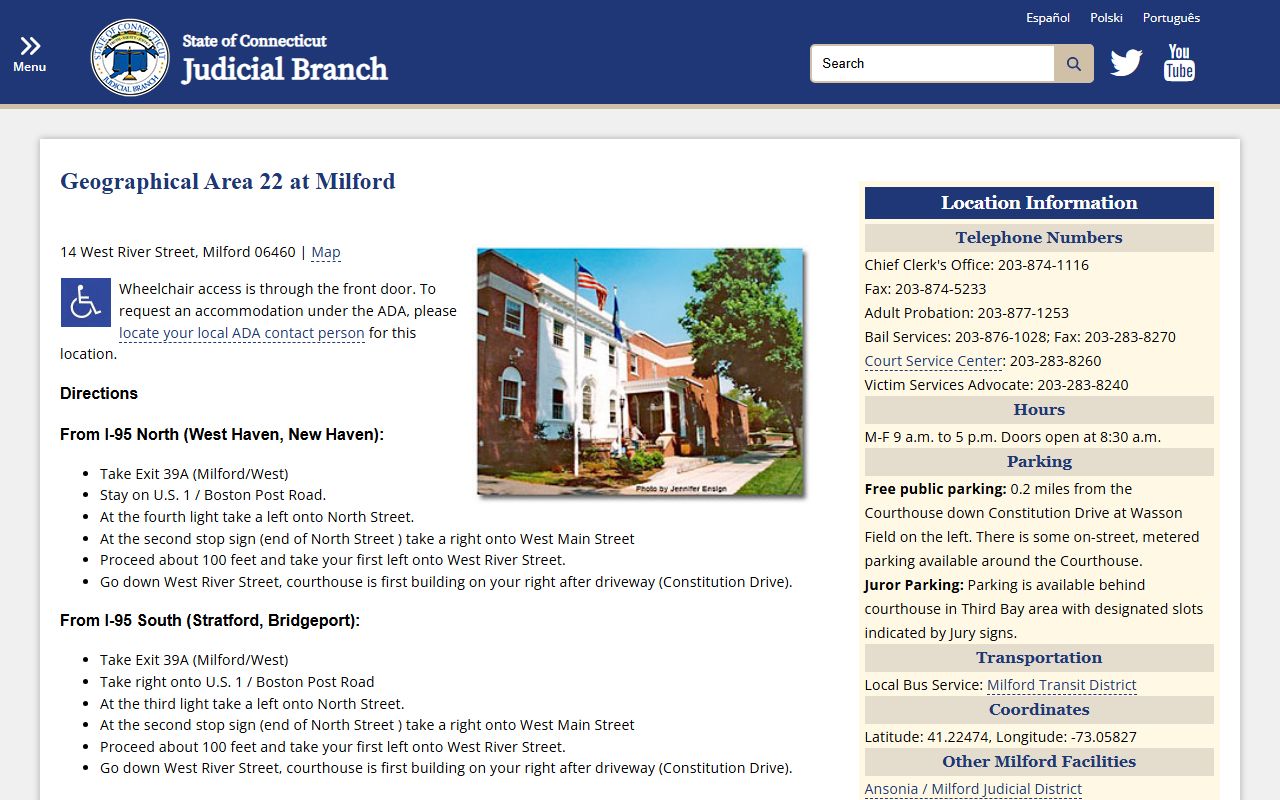
That listing carries the courthouse address and the GA 22 clerk line, 203-874-1116, which is the number to call when a Milford court record is not available through the online lookups.
Arrest Charges vs. Court Charges
A common surprise is that the charges at arrest do not always match the charges in the court record. The police record reflects what an officer believed at the scene. The court record reflects what the prosecutor decided to pursue after reviewing the file. Between those two steps, charges can be amended, reduced, added, dropped, or dismissed.
The Milford Police side appears in the department's daily press releases and arrest logs, which list the incident, date, report number, officer, location, the arrestee, the charges, the bond, and a court date. Those documents do not include a booking photo. The court side appears in the Judicial Branch case lookup, which tracks the charges as they change through the case. Reading both gives the full story of an arrest that became a court record.
| Status | What It Means |
|---|---|
| Pending | The charge is filed and the case is still open and moving through court. |
| Amended or Reduced | The prosecutor changed the charge, often to a lesser offense, after review. |
| Dismissed | The court ended the charge, and it is no longer being pursued. |
| Nolle Prosequi | The prosecutor chose not to pursue the charge for now; it can become final later. |
Note: Booking charges in a Milford Police press release are a starting point, and the prosecutor's filed charges in the court record are what control the case.
Charges vs. Convictions in the Court Record
Being arrested and charged is not the same as being convicted. A charge is an accusation that the case is not over. A conviction is the outcome after a plea or a verdict. The court record shows both stages, but they carry very different weight, and they live in separate parts of the Judicial Branch system.
| Charge | Conviction | |
|---|---|---|
| Stage | Accusation, case open | Plea or verdict, case decided |
| Proof | Probable cause | Beyond a reasonable doubt |
| Where to Search | Pending case lookup | Conviction by defendant lookup |
Convictions are searched separately from pending cases, by defendant name or by docket number. The Judicial Branch posts a hard limit on how long a conviction shows: generally no more than 10 years after sentencing, unless Connecticut Practice Book section 7-13 sets a shorter display period. Youthful offender cases, juvenile cases, infractions, and violation convictions are not shown at all. The data can also change from one day to the next because of erasures, corrections, pardons, and modifications.
You can check past outcomes on the Connecticut Judicial conviction by defendant lookup.
Bond and Bail After a Milford Arrest
Bail for a Milford arrest starts at the police station. Officers set a bail amount at arrest. If the person cannot make that amount, police must notify bail staff, and Pretrial Services can review the figure and adjust it. Milford Police press releases show both promise-to-appear releases and dollar bonds, with examples that have included $750, $1,000, $2,500, and $15,000.
Where you post bail depends on where the person is held. Bail can be posted at the police department where the person is locked up, at the courthouse, or at the Department of Correction facility holding them. For a Milford arrest, the police department is at 430 Boston Post Road, the local court is GA 22 at 14 West River Street, and a person in state custody may be at Bridgeport Correctional Center or another Connecticut DOC facility.
| Bond Type | How It Works |
|---|---|
| Promise to Appear | The person is released with a court date instead of staying in custody. This is common in Milford press releases. |
| Full Cash | The full amount is posted through the police, court, or DOC channel, depending on where the person is held. |
| 10% Cash Option | As of January 1, 2020, this is automatically available for bonds of $20,000 or less, with exceptions. Check the order. |
| Surety / Bondsperson | A licensed Connecticut bail bondsperson posts surety on the person's behalf. |
| No Release / Hold | Another warrant, detainer, or remand controls, so posting one bond does not free the person. |
A detainer is a hold placed by another agency, such as a court, the Department of Correction, or immigration authorities, that keeps a person in custody even when a bond is met. The Judicial Branch explains the statewide process in its bail FAQ. After release, the person still has a court date, and missing it can lead to a warrant. Use the case lookup alongside any custody search, since roster charges and court charges may not match after prosecutor review.
You can read the statewide procedure on the Connecticut Judicial Branch bail FAQ.
Warrants, FTA, and VOP Searches
Milford Police do not publish a public active-warrant list. The official online warrant channel for Connecticut is the Judicial Branch search for violation of probation, failure to appear, and orders to incarcerate. A failure to appear, or FTA, is issued when a defendant misses a required court date. A violation of probation, or VOP, follows an alleged probation breach. An order to incarcerate is a court order directing custody.
The warrant search runs on a last name, with optional town and court filters. You need at least the first two letters of the last name to start.
| Field | Type | Required | Notes |
|---|---|---|---|
| Last Name | Text | Yes | At least the first two letters, up to 30 characters |
| Town | Dropdown | No | Includes MILFORD |
| Court Location | Dropdown | No | Includes Milford GA 22 and Milford Judicial District |
You can search outstanding orders on the Connecticut Judicial warrant search for VOP, FTA, and orders to incarcerate.
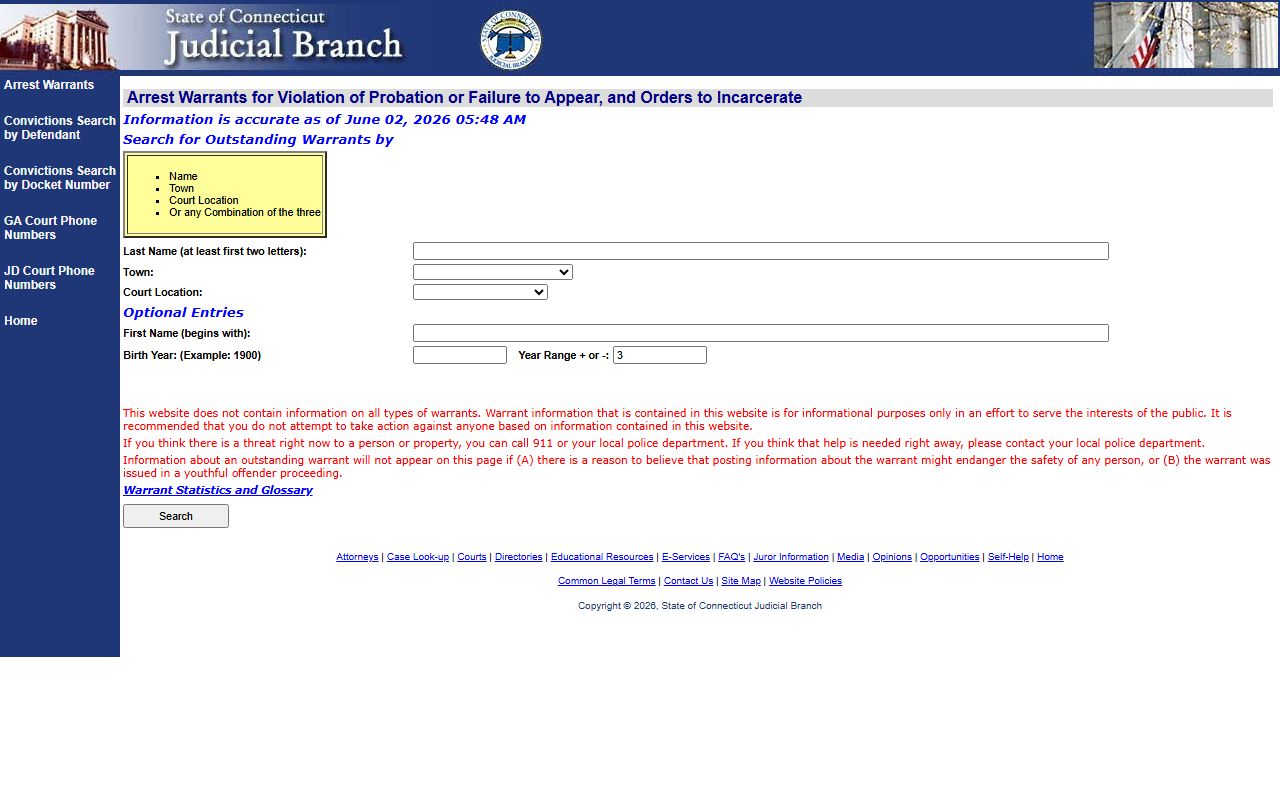
That tool covers a narrow slice of warrants, which is why a clean result there does not mean a person is clear of every order.
The Judicial Branch warns that the site does not list all warrant types, that the listing is informational only, and that no one should act on a result. It also warns that an outstanding warrant may not appear if posting it could endanger someone or if it came out of a youthful offender proceeding. For warrant surrender or clearance, talk to an attorney rather than relying on a web search. When the online tools come up short, call the GA 22 clerk at 203-874-1116, Milford Police Records at 203-874-4615, or the State's Attorney teams.
Juvenile and Youthful Offender Limits
Not every Milford case is searchable online, and the law draws a firm line around young people. Juvenile matters are confidential and handled through juvenile channels, so they do not surface in the ordinary public case lookup. Connecticut General Statutes section 46b-124 makes juvenile matter records confidential except through listed statutory access channels and court orders.
Youthful offender cases carry similar protection. The Judicial Branch notes that youthful offender cases, along with juvenile cases, infractions, and violation convictions, are excluded from the conviction lookup. The warrant search also leaves out warrants issued in youthful offender proceedings. So a missing result for a younger person often reflects the law, not a clean record.
Erasure and Why Court Records Disappear
Connecticut court records can vanish from a search by design. The state's erasure laws remove qualifying records after certain outcomes, which is one reason a case you saw last month may be gone today. This is different from sealing. A sealed record is hidden from public view but still exists; an erased record is treated as though the charge never happened.
| Sealed or Restricted | Erased | |
|---|---|---|
| Public View | Hidden from the public lookup | Removed and treated as never occurring |
| Triggered By | Court order, confidentiality rules, pending limits | Dismissal, not guilty, certain nolles, pardons |
| Example | Juvenile and youthful offender records | A dismissed Milford charge under CGS 54-142a |
Three statutes drive erasure. CGS 54-142a sets the erasure rules for qualifying records after outcomes such as a dismissal, a not guilty finding, certain nolles, and pardons. CGS 54-142e places deletion and update duties on the agencies that hold erased records. CGS 54-142t provides for automated erasure. In plain terms, when a charge ends in your favor, the law can scrub it from the public court record, and the search tools update accordingly.
Connecticut law also makes arrest records public from the moment of arrest under CGS 1-215. That openness does not override juvenile confidentiality, youthful offender confidentiality, erasure, sealed material, or victim and witness redactions. So a public arrest record and a court record can both exist while parts of either stay out of reach.
Note: A dismissed or erased Milford charge can drop out of the public lookup entirely, so an empty search result does not always mean an arrest never happened.
Clerk and Prosecutor Contacts for Milford Court Records
When the online lookups do not show what you need, the people who hold the records can help. The GA 22 clerk at the Milford courthouse handles court files, certified copies, and scheduling questions, reachable at 203-874-1116. The State's Attorney teams answer charging questions: Part A at 203-874-3361 and the GA 22 Part B prosecutor at 203-874-3017. Both share the 14 West River Street courthouse and the email conndcj@ct.gov.
For the police side of an arrest, Milford Police Records at 430 Boston Post Road handles report requests at 203-874-4615, and the department's main line is 203-878-6551. Police copies run $0.50 per page, with prepayment required when the estimate reaches $10 or more, under CGS 1-212. The Division of Criminal Justice also keeps a public criminal case lookup page that explains how the search works and which Ansonia-Milford courts apply. Start with the agency that created the record, and call ahead before traveling, since custody and court information can change quickly.